Uncategorized

The Six Pillars Behind Every Executive Decision

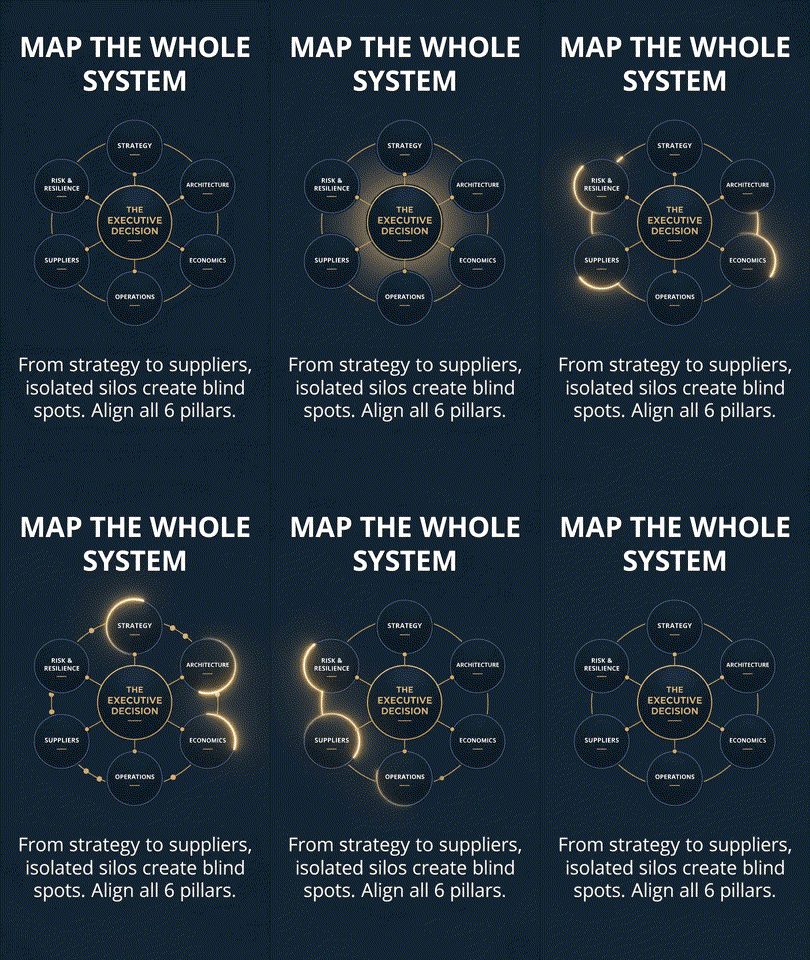
Map the Whole System  The meeting that looked like a decision A few years ago I sat in a boardroom while a company approved a major technology investment. The strategy deck was polished. The business case showed a healthy return. The vendor demo had gone well. The vote was unanimous, and everyone left the room feeling like leaders. Eighteen months later, the program was late, the budget had nearly doubled, and the COO was quietly asking why operations had never been consulted about the rollout sequence. Nobody in that room had made a bad decision in isolation. Every individual pillar – strategy, architecture, economics, operations, suppliers, risk – had an owner, and every owner had done their job. But nobody owned the system. And that is where executive decisions actually live or die. That pattern is not rare. McKinsey surveyed 2,207 executives and found that only about a third believed the quality of decision-making in their organizations was very good – and 60% thought bad decisions were about as frequent as good ones. In a later large-scale study on CEO blind spots, McKinsey compared how CEOs rated themselves against how their boards and direct reports rated them across the six core responsibilities of the role – including aligning the organization – and found meaningful perception gaps: “unconsciously unskilled” zones where leaders don’t know what they don’t know. Organizational alignment sits precisely at the fault line between a decision and its consequences. Decision-quality gap – McKinsey survey of 2,207 executives The uncomfortable truth: most executive decisions are not wrong because leaders lack intelligence or information. They are wrong because the decision is made through a keyhole while the system around it stays invisible. The anatomy of an executive decision Over years of leading technology organizations – and advising boards and executive teams – I have come to map every significant decision as a system of six pillars orbiting one center: Strategy – Why are we doing this, and does it serve where we are going? Architecture – Can our systems, data, and organization actually carry it? Economics – What does it truly cost, and where does the value accrue? Operations – Can we run it, support it, and absorb the change? Suppliers – Who else holds our fate in their hands? Risk & Resilience – What happens when – not if – it goes wrong? Miss one pillar and you don’t get a slightly worse decision. You get a blind spot. And blind spots compound: a strategy-architecture gap becomes a budget overrun; an operations-supplier gap becomes an outage with no owner; an economics-risk gap becomes a breach you assumed was someone else’s problem. Alignment vs. decision outcome — illustrative model based on practitioner observation, not a statistical study Let’s walk the pillars the way I walk them with executive teams – with the questions, the data, and the stories that make each one concrete. The six pillars around the executive decision 1. Strategy: the decision must earn its place Every executive decision is a claim on finite resources, and strategy is the ledger that decides whether the claim is honored. The question is not “is this a good idea?” but “is this the best use of our next dollar, our next hundred people, our next year?” Here is what makes this pillar hard in practice: strategy is usually articulated at altitude, while decisions are made at ground level. The strategy says “customer-centric digital transformation.” The decision on the table is a $4M integration platform. Between those two statements lies an interpretive gap, and into that gap fall the most expensive misalignments I have seen. A composite example from my consulting work: a retail group approved a personalization engine because “personalization” appeared in its strategy deck. Nobody had asked the strategy-pillar question properly: which strategic outcome, measured how, and by when? Eight months in, marketing was optimizing click-through while the strategy actually prioritized basket size and retention. Same tool, same spend – different war. When we reframed the decision around the real strategic metric, the configuration, the data priorities, and even the vendor shortlist changed. The data: This gap between strategic intent and executional agility is measurable. In Gartner’s 2026 CIO and Technology Executive Survey – drawing on 2,500 participants – only 18% of CIOs said they can adjust technology investments and deployment plans at the pace their evolving business conditions require. Strategy that cannot be re-aimed is not strategy; it is a museum exhibit. Only 18% of CIOs can adjust technology investments at the required pace – Gartner 2026 CIO Survey The question I put to boards: If this decision succeeds completely, which line in the strategy document moves – and how will we know? 2. Architecture: the silent vote on everything Architecture is the only pillar that never attends the meeting and always determines the outcome. MIT’s Center for Information Systems Research (CISR) made this rigorous in Enterprise Architecture as Strategy (Ross, Weill & Robertson, 2006): companies that deliberately align their operating model – how standardized and how integrated their processes are – with their architecture outperform those that let architecture emerge by accident. The framework’s four operating models (Coordination, Unification, Diversification, Replication) are still the cleanest way I know to force the strategy-architecture conversation. Later MIT CISR research added a second, equally important lens: decision rights. Studying how organizations empower decentralized teams, CISR identified four guardrails that keep local decisions aligned with enterprise interests – guardrails built around purpose, data, policies, and resource allocation. In other words: architecture is not just systems. It is who is allowed to decide what, with which data, under which rules. The story I tell: In one organization, three business units each selected “best-of-breed” tools for the same function within the same year. Each decision was locally rational; each was defended in its own business case; each passed its own approval gate. The enterprise result: three contracts, three data models, three support models, and an integration bill that dwarfed any of the three

The Six Pillars Behind Every Executive Decision Read More »
How Observability Could Turn a Data Center into a Profit Center

Imagine a 3 MW data center spread across multiple zones, filled with enterprise-grade equipment, co-location tenants, and the usual complexities: redundant feeds, temperature differentials, embedded monitoring units, and a patchwork of legacy monitoring tools. Now imagine this facility not as a cost center, but as a source of strategic profitability. That’s the shift I’ve been advocating for one where observability isn’t a technical upgrade, but a financial lever. This is a suggestion for what could be done, built from years of experience across infrastructure, compliance, and data center optimization. Why Observability is a Financial Architecture Too often, data center operators think of observability in purely operational terms: “Know when something fails.” But what if the goal isn’t just resilience – it’s return? In a modern regulatory and ESG-driven world, observability provides: Financial precision (per-socket energy visibility → accurate cost attribution) Risk mitigation (predictive insights → SLA compliance and uptime) Regulatory readiness (EU directives → data lineage, auditability, traceability) Capacity efficiency (avoid overprovisioning and underutilization) I built a model to illustrate this. Here’s what it looks like. A Hypothetical Financial Case Study Let’s model a typical mid-sized facility operating under traditional tools, then project the financial outcomes if it embraced open-source observability with intelligent telemetry, NetBox-backed CMDB, and a data lake powered by the ELK stack. Annual Financial Comparison – Modeled Outcomes Category Legacy Tooling (€) Open-Source Observability (€) Power Cost (OPEX) 1,200,000 950,000 Cooling Cost (OPEX) 800,000 650,000 Maintenance & Downtime 400,000 150,000 DCIM Licensing Fees 250,000 0 Staffing Costs (Monitoring) 300,000 250,000 Compliance Penalties 100,000 0 Revenue from Co-Location 2,500,000 2,750,000 Total Operating Cost 3,050,000 2,000,000 Net Profit -550,000 +750,000   Design Assumptions Behind the Model Power savings come from load balancing, phase correction, and proactive alerts. Cooling efficiency is gained by aligning heatmaps and airflow telemetry to physical containment. Downtime is slashed via deviation tracking and threshold-based alerting. Licensing fees are eliminated with open-source telemetry (e.g., SNMP, Redfish, OpenTelemetry). Revenue grows due to improved SLA delivery, tenant confidence, and resource transparency. Strategic Takeaways This is more than theory – it’s a practical lens to redesign how we see infrastructure. Deviations aren’t errors—they’re opportunities. Your telemetry is a balance sheet in disguise. Compliance data, when automated, becomes ESG capital. Open source, when structured, outperforms black-box DCIMs. And perhaps most importantly: Every kilowatt, every alert, every outlet reading is a conversation between engineering and finance – if you have the platform to listen. Closing Thought This model is fictional – but everything about it is real. The tools exist. The outcomes are provable. The only variable is the decision to redesign your observability landscape with business value in mind. As a strategist, I don’t just design architectures – I help organizations reframe infrastructure as a source of advantage. And in a world where compliance is mandatory and efficiency is monetized, observability is no longer optional. It’s the control panel for profitability.

How Observability Could Turn a Data Center into a Profit Center Read More »

Strong Vendor Management as a Leadership Discipline

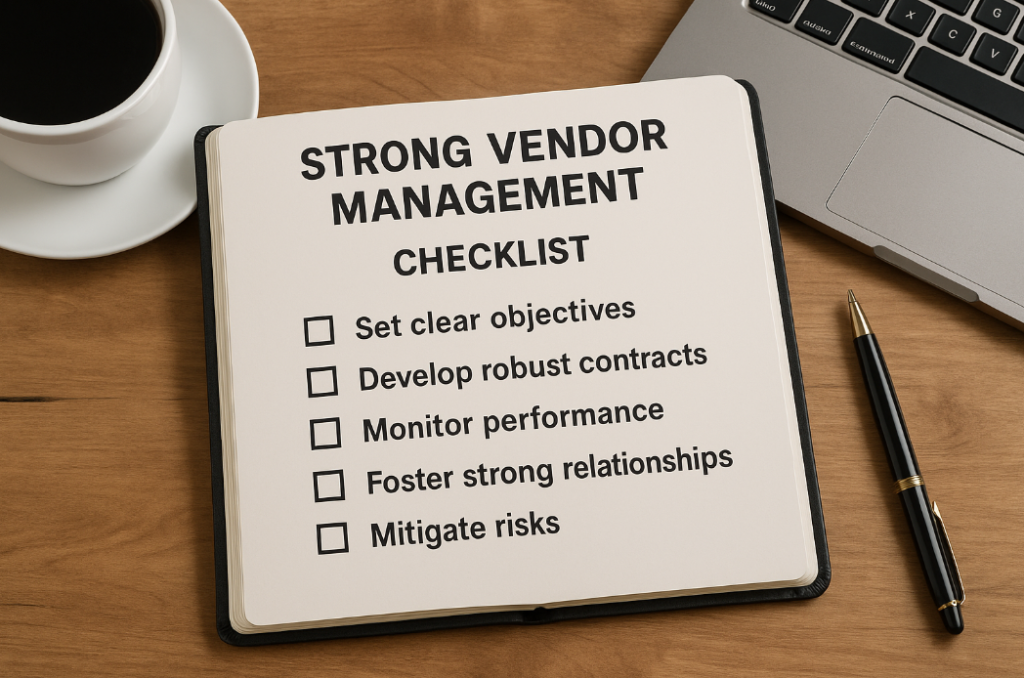
A Strategic Perspective for Executives In the course of leading complex transformation programs – spanning cloud migration, hybrid IT modernization, and regulatory compliance across international enterprises, I have encountered a recurring pattern – when a critical vendor underperforms, the root cause is rarely just technical. More often, it is organizational. And, in some cases, it is personal. A few years ago, during a large-scale infrastructure transition involving multiple third parties, one of our key vendors failed to deliver on a major milestone. The impact was significant – delays in go-live, regulatory risk exposure, and executive scrutiny. While post-mortem efforts focused initially on contractual terms and SLA breaches, a single comment from the client’s CIO reframed the situation entirely.  “If this vendor was so critical, why didn’t we make them feel like it?” This prompted a fundamental reassessment. In retrospect, the failure was less about performance and more about enablement. We had underestimated the importance of vendor alignment, onboarding, and strategic integration. Since then, I have approached vendor relationships not as procurement-driven transactions, but as leadership-led partnerships. From Transaction to Strategic Enablement In traditional procurement models, vendors are treated as external entities tasked with narrowly defined outputs. However, this model does not hold in contemporary IT ecosystems where resilience, compliance, innovation, and speed are contingent on externally provided capabilities. Today, many of the most mission-critical services in an enterprise cloud platforms, observability frameworks, security layers, managed infrastructure are delivered not by internal teams, but by extended ecosystems. In such environments, strong vendor management becomes a strategic competency, not an administrative function. Executives who continue to treat vendor relationships as peripheral are exposed to significant risks: Lack of visibility into operational dependencies Delayed detection of delivery misalignments Compliance vulnerabilities due to integration gaps Innovation fatigue due to minimal engagement These risks are magnified in complex programs involving regulated industries, geographically distributed teams, or highly integrated architectures. Five Foundational Principles for Effective Vendor Leadership Based on direct experience managing vendor ecosystems across multiple transformation initiatives, I propose the following five principles as foundational for strong vendor engagement. These are not theoretical constructs, but tested practices applied in real-world programs. 1. Provide Strategic and Operational Context Early Vendors are often handed specifications, SLAs, and deliverables… – but rarely the broader business rationale. This limits their ability to make informed decisions when challenges emerge. Senior leaders should ensure that vendors are given sufficient exposure to strategic objectives, organizational constraints, and stakeholder expectations from the outset. 2. Establish Joint Success Criteria and Governance Cadence Rather than unilaterally imposed performance indicators, success should be co-defined through a collaborative process. This includes establishing joint KPIs, agreeing on outcome-based metrics, and implementing recurring governance rituals such as monthly reviews, capability assessments, and issue prevention forums. 3. Promote Embedded Participation in Planning and Decision-Making Vendor teams perform optimally when they are treated as contributors rather than executors. Inclusion in roadmap reviews, sprint planning, retrospectives, and risk discussions allows vendors to adapt proactively and contribute insights based on cross-industry expertise. 4. Enable Transparency Through Structured Communication Channels Problems do not disappear when unspoken. They escalate. Executive sponsors should establish clear protocols for surfacing concerns, escalating issues, and conducting root cause analyses in a constructive, non-punitive environment. Equally important is the recognition of exemplary performance and early delivery wins. 5. Invest in Vendor Capability Maturity and Long-Term Alignment High-performing vendor ecosystems are often co-developed. Providing access to documentation, security frameworks, architectural reviews, and where appropriate – training sessions, accelerates delivery and builds loyalty. In some engagements, I have seen long-term vendors outperform newer entrants purely due to continuity, context depth, and trust. A Practical Checklist for Executive Leaders To operationalize the above principles, the following checklist may be applied across vendor engagements: Ensure that vendors are provided with a structured onboarding that includes not only contractual obligations but also strategic context and relevant organizational constraints. Co-create success metrics that include both delivery KPIs and qualitative outcome indicators such as stakeholder satisfaction, compliance readiness, and adaptability. Define a recurring governance rhythm that includes formal reviews, but also informal touchpoints with business and technical sponsors. Integrate key vendor leads into decision-making processes, particularly during architectural changes, regulatory planning, or risk assessments. Encourage continuous feedback loops that identify process inefficiencies and improvement opportunities on both sides. Provide controlled access to knowledge resources that enable vendors to accelerate onboarding and improve alignment (e.g., internal playbooks, compliance guidelines, CMDB documentation). Establish vendor scorecards that evolve over time tracking not only contractual adherence but also relationship quality, innovation delivered, and cultural fit. Treat vendors as long-term partners, fostering a culture where mutual investment leads to mutual performance. Leadership as the Differentiator Ultimately, the quality of a vendor relationship is a reflection of leadership, not procurement strategy. Organizations that succeed in digital transformation, cloud adoption, or operational resilience do so not because of the number of vendors they engage but because of how they lead those relationships. In environments where systems are interdependent and timelines are unforgiving, strong vendor management is a core leadership capability. It requires clarity, structure, empathy, and consistency. And it delivers dividends through resilience, trust, innovation, and reduced risk exposure. If your enterprise depends on external providers for mission-critical capabilities, I encourage you to examine not just who you partner with, but how you lead those partnerships. The difference between performance and disruption often lies there.

Strong Vendor Management as a Leadership Discipline Read More »

From Dark Rooms to Boardrooms

Data-Centre Observability Is the C-Suite’s Next Competitive Edge ⚡️ Europe’s data centres already soak up 2 – 4 % of total EU electricity and the number is climbing fast thanks to AI workloads.  Meanwhile, the revised Energy-Efficiency Directive (EU 2023/1791) and its 2024 Delegated Regulation demand that every facility above 500 kW publish granular power-and-water KPIs in an EU-wide database by 15 September 2024 with non-compliance carrying financial penalties. Why This Hits the Boardroom First Regulatory exposure. Public sustainability dashboards make outages and inefficiencies impossible to hide. Capital constraints. ESG funds are pulling out of opaque infrastructures; clarity equals cheaper capital. Grid bottlenecks. Utilities now vet expansion plans against real-time load data-laggards lose power-up slots. The Observability Playbook I’ve Honed Over 15 Years Instrument everything. Socket-level telemetry and firmware inventories mapped to a living CMDB. Correlate in real time. Merge energy, thermal and asset data into a single analytics fabric that speaks both kilowatts and KPIs. Automate governance. Policy-as-code that flags deviations, opens tickets and self-heals configuration drift. Typical outcomes from recent engagements 50 % faster MTTR by eliminating blind-spot troubleshooting. Live PUE ≤ 1.30, beating upcoming EU benchmarks. CapEx forecast accuracy within ±5 % thanks to AI-driven capacity twins. Three Board-Level Moves for 2025 Move Immediate Win Strategic Upside Publish real-time PUE & WUE De-risk compliance audits Builds investor trust Link BMS to Finance Turns energy data into € per workload Enables usage-based billing Monetise waste heat New revenue stream Cuts scope-1 emissions   Why Talk to Me? I translate the language of rack rows and revenue for executives who need fast, regulation-ready clarity. Whether you’re running edge closets or 100 MW hyperscale campuses, I can help you:  Size your true energy cost in under 10 days  Build a roadmap that satisfies auditors and investors  Unlock hidden EBITDA by productising efficiency wins Ready to turn your data centre from a cost centre into a sustainability showcase?👉 DM me or comment below coffee’s on me if we don’t uncover at least one saving potential in our first workshop. Pavel Stoyanov – turning infrastructure insight into executive advantage.

From Dark Rooms to Boardrooms Read More »

Competency in the Cloud: Standard Roles Explained

Join us as we talk with Pavel Stoyanov, a transformative tech leader with over 20 years of experience at top firms like Accenture, HP, Oracle, and SAP. In this episode, Pavel explains “Competency in the Cloud: Standard Roles Explained,” sharing his expertise in integrating business goals with cutting-edge tech solutions. Discover how he drives growth and operational excellence through #Cloud, #DevOps, #AIIntegration, and more. Don’t miss insights from a visionary at the forefront of digital transformation.  https://www.youtube.com/watch?v=ycgGX1J_mFM

Competency in the Cloud: Standard Roles Explained Read More »

gf805a2b43bd500f8078c68ff69459b475bf7f6d75d5a9ea1f52c860e0675d42fdf1e847a16aed627ec4bc1a8b73fda8ab4c8d1b30045753de6c0457f324f906f_1280-1846400.jpg

The AI-Cybersecurity Chessboard: Who Holds the Advantage?

Imagine you’re a chess player, seated across from an opponent whose moves you can barely anticipate. Now, imagine that opponent is not human, but an intelligent machine, one that not only knows the game but can rewrite the rules as you play. Welcome to the world of generative AI and cybersecurity—a world where the distinction between attacker and defender blurs, and where the stakes are nothing less than the security of our digital lives. In this high-stakes game, who holds the advantage? According to the World Economic Forum’s Global Cybersecurity Outlook Report for 2024, the outlook isn’t promising for defenders.  Over half of global executives believe that, within the next two years, attackers will have the upper hand. This isn’t just a prediction; it’s a call to arms for a complete reimagining of cybersecurity in the age of AI. Generative AI is a double-edged sword, one that is already being wielded by both sides. On one hand, businesses and governments are using AI to push boundaries, driving innovation and efficiency. On the other, cybercriminals are capitalizing on the very same technology, launching increasingly sophisticated attacks. Take, for instance, the 76% spike in ransomware incidents since ChatGPT’s debut in late 2022, or the astronomical 1,265% rise in phishing attacks, both fueled by AI-driven tools. The battlefield is not just theoretical; it’s all too real. Cybercriminals have already turned to the dark web to buy and sell malicious large language models (LLMs) like FraudGPT and PentestGPT, tools designed to automate and escalate their attacks. Priced at just $200 a month, these LLMs are the new weapons of choice, empowering attackers to scale their operations with unprecedented efficiency. Consider the recent case in Hong Kong, where a $25 million heist was executed using deepfake technology. The scammers didn’t just imitate an executive—they digitally resurrected him on a conference call, issuing fake instructions to transfer funds. This isn’t science fiction; it’s happening now, and it’s just the beginning. The threat landscape is evolving at a dizzying pace. Hacktivist groups like Ghost Sec are experimenting with dark LLMs to create obfuscated, Python-based ransomware, increasing their attack success rates exponentially. Industries such as financial services, government, and energy, which rely heavily on sophisticated technology, find themselves particularly in the crosshairs. These sectors are now racing to develop tailored defenses to counter these AI-powered threats. As organizations move from AI pilot projects to large-scale deployments, the complexity and scale of potential attacks grow exponentially. We’re talking about risks that range from disrupting AI models to injecting malicious prompts, and even the theft or manipulation of training data. These are not your traditional cybersecurity threats, and most organizations are woefully unprepared. So, where does this leave us? The key to navigating this new terrain is not just about defense—it’s about embedding security into the very fabric of your AI journey. Organizations that see security as a catalyst rather than a constraint will be the ones that thrive in this new era. Here’s how to start: Integrate AI Security into Governance, Risk, and Compliance (GRC): Gen AI security should be woven into your GRC framework, with clear governance structures and processes that keep up with regulatory changes. Partnerships with regulators can help shape the future landscape, much like the European Union AI Act and the Biden administration’s executive order are beginning to do. Conduct a Thorough AI Security Assessment: Regular security assessments, informed by the latest intelligence, are crucial. Evaluate your AI architectures against best practices and identify vulnerabilities. A range of tools can offer deep insights into strengthening your AI defenses. The game has changed. The question is not just whether you can defend against AI-powered threats, but whether you can protect your AI systems themselves. The organizations that move quickly, embedding security by design, will not only survive—they’ll lead the way in this brave new world of generative AI. If you are in this situation then… Drop me a line

The AI-Cybersecurity Chessboard: Who Holds the Advantage? Read More »