Map the Whole System
The meeting that looked like a decision
A few years ago I sat in a boardroom while a company approved a major technology investment. The strategy deck was polished. The business case showed a healthy return. The vendor demo had gone well. The vote was unanimous, and everyone left the room feeling like leaders.
Eighteen months later, the program was late, the budget had nearly doubled, and the COO was quietly asking why operations had never been consulted about the rollout sequence. Nobody in that room had made a bad decision in isolation. Every individual pillar – strategy, architecture, economics, operations, suppliers, risk – had an owner, and every owner had done their job.
But nobody owned the system. And that is where executive decisions actually live or die.
That pattern is not rare. McKinsey surveyed 2,207 executives and found that only about a third believed the quality of decision-making in their organizations was very good – and 60% thought bad decisions were about as frequent as good ones. In a later large-scale study on CEO blind spots, McKinsey compared how CEOs rated themselves against how their boards and direct reports rated them across the six core responsibilities of the role – including aligning the organization – and found meaningful perception gaps: “unconsciously unskilled” zones where leaders don’t know what they don’t know. Organizational alignment sits precisely at the fault line between a decision and its consequences.
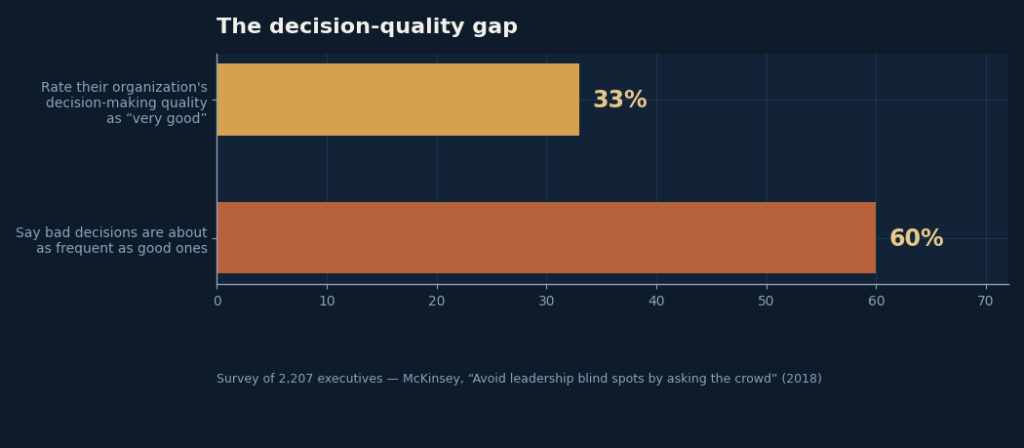
Decision-quality gap – McKinsey survey of 2,207 executives
The uncomfortable truth: most executive decisions are not wrong because leaders lack intelligence or information. They are wrong because the decision is made through a keyhole while the system around it stays invisible.
The anatomy of an executive decision
Over years of leading technology organizations – and advising boards and executive teams – I have come to map every significant decision as a system of six pillars orbiting one center:
- Strategy – Why are we doing this, and does it serve where we are going?
- Architecture – Can our systems, data, and organization actually carry it?
- Economics – What does it truly cost, and where does the value accrue?
- Operations – Can we run it, support it, and absorb the change?
- Suppliers – Who else holds our fate in their hands?
- Risk & Resilience – What happens when – not if – it goes wrong?
Miss one pillar and you don’t get a slightly worse decision. You get a blind spot. And blind spots compound: a strategy-architecture gap becomes a budget overrun; an operations-supplier gap becomes an outage with no owner; an economics-risk gap becomes a breach you assumed was someone else’s problem.
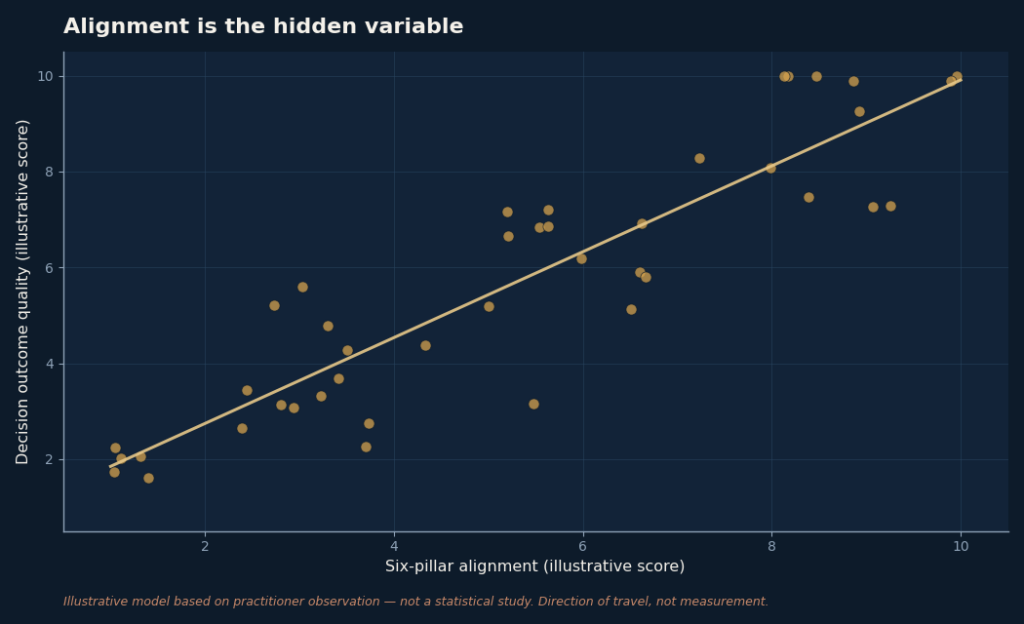
Alignment vs. decision outcome — illustrative model based on practitioner observation, not a statistical study
Let’s walk the pillars the way I walk them with executive teams – with the questions, the data, and the stories that make each one concrete.
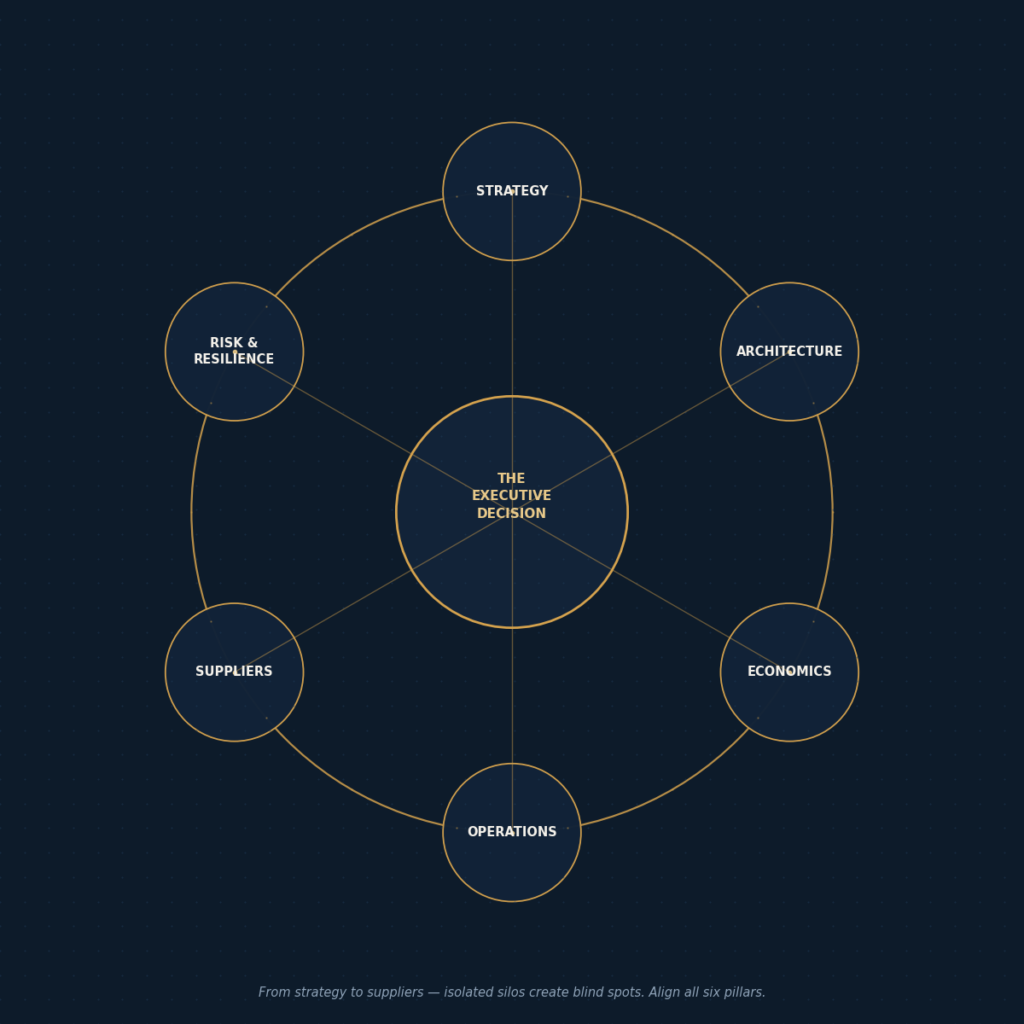
The six pillars around the executive decision
1. Strategy: the decision must earn its place
Every executive decision is a claim on finite resources, and strategy is the ledger that decides whether the claim is honored. The question is not “is this a good idea?” but “is this the best use of our next dollar, our next hundred people, our next year?”
Here is what makes this pillar hard in practice: strategy is usually articulated at altitude, while decisions are made at ground level. The strategy says “customer-centric digital transformation.” The decision on the table is a $4M integration platform. Between those two statements lies an interpretive gap, and into that gap fall the most expensive misalignments I have seen.
A composite example from my consulting work: a retail group approved a personalization engine because “personalization” appeared in its strategy deck. Nobody had asked the strategy-pillar question properly: which strategic outcome, measured how, and by when? Eight months in, marketing was optimizing click-through while the strategy actually prioritized basket size and retention. Same tool, same spend – different war. When we reframed the decision around the real strategic metric, the configuration, the data priorities, and even the vendor shortlist changed.
The data: This gap between strategic intent and executional agility is measurable. In Gartner’s 2026 CIO and Technology Executive Survey – drawing on 2,500 participants – only 18% of CIOs said they can adjust technology investments and deployment plans at the pace their evolving business conditions require. Strategy that cannot be re-aimed is not strategy; it is a museum exhibit.
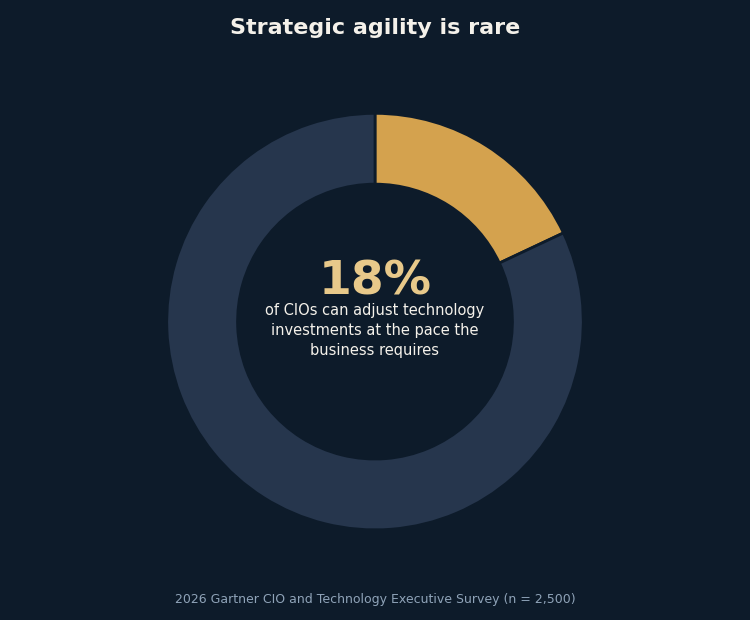
Only 18% of CIOs can adjust technology investments at the required pace – Gartner 2026 CIO Survey
The question I put to boards: If this decision succeeds completely, which line in the strategy document moves – and how will we know?
2. Architecture: the silent vote on everything
Architecture is the only pillar that never attends the meeting and always determines the outcome. MIT’s Center for Information Systems Research (CISR) made this rigorous in Enterprise Architecture as Strategy (Ross, Weill & Robertson, 2006): companies that deliberately align their operating model – how standardized and how integrated their processes are – with their architecture outperform those that let architecture emerge by accident. The framework’s four operating models (Coordination, Unification, Diversification, Replication) are still the cleanest way I know to force the strategy-architecture conversation.
Later MIT CISR research added a second, equally important lens: decision rights. Studying how organizations empower decentralized teams, CISR identified four guardrails that keep local decisions aligned with enterprise interests – guardrails built around purpose, data, policies, and resource allocation. In other words: architecture is not just systems. It is who is allowed to decide what, with which data, under which rules.
The story I tell: In one organization, three business units each selected “best-of-breed” tools for the same function within the same year. Each decision was locally rational; each was defended in its own business case; each passed its own approval gate. The enterprise result: three contracts, three data models, three support models, and an integration bill that dwarfed any of the three licenses. No single decision was wrong. The system of decisions was unarchitected.
The question I put to boards: What does the organization we are becoming require this decision to be compatible with – and who has the right to say no when it isn’t?
3. Economics: unit economics, not business cases
Every executive decision arrives wearing a business case. The problem is that business cases are written to be approved, not to be true. They assume adoption, ignore transition costs, price the vendor’s list rate, and treat “productivity gains” as a bankable asset.
The economics pillar asks harder questions:
- Total cost: license + integration + data migration + dual-running + decommissioning + the organizational change tax. In my experience, the visible line item is rarely more than half the true cost of a significant platform decision.
- Cost of delay and cost of wrong: Gartner’s own research puts the cost of poor data quality at at least $12.9 million per year on average (2020 research, still cited by Gartner today) – a figure that rarely appears in anyone’s ROI model, because the cost hides inside a thousand small decisions made with bad information.
- Option value: does this decision create future choices or consume them? A platform that locks you into a vendor’s roadmap has a hidden liability line that most business cases omit.
The composite example: a company compared two integration approaches – one cheaper upfront, one more expensive but standardized. The business case favored the cheap one by $1.2M. When we added the cost of the three parallel integrations per year, the duplicated effort in every subsequent project, and the exit penalty, the “cheap” option was more expensive within 24 months. The spreadsheet hadn’t lied. It had simply been born cross-eyed.
The question I put to boards: Show me the unit economics after go-live – cost per transaction, per user, per integration – not just the approval-year math.
4. Operations: the org chart is part of the system
Decisions do not fail in slideware; they fail at 2 a.m. in an operations queue. The operations pillar asks whether the people, processes, and service model can actually carry the decision – and whether the organization chart quietly contradicts it.
The classic failure mode: a decision is made by one function, run by another, and paid for by a third. When a program is “IT-led” but the change lands on operations, the real cost sits in overtime, workarounds, and attrition – none of which appears in the program budget.
The antidote I use is borrowed from MIT CISR’s guardrails: before approving a major decision, define who owns the run-state, what service levels apply, and how operational feedback reaches the decision-makers. If a decision cannot name its operational owner, it is not a decision yet – it is a wish.
The question I put to boards: Who is on call for this decision when it misbehaves – and do they have the authority and the budget to fix it?
5. Suppliers: your system extends beyond your walls
This is the pillar most executive teams systematically underweight. Modern organizations are compound structures: your capabilities increasingly live in your vendors’ roadmaps, your SaaS providers’ uptime, your outsourcers’ hiring plans.
The data here deserves attention. Gartner has predicted that 92% of companies will lack full end-to-end supply chain resiliency – a staggering acknowledgment that most enterprises cannot actually see their own extended system. And IBM’s 2026 Cost of a Data Breach Report found that one in four malicious breaches were AI-enabled – a 56% year-over-year increase – costing an average of $6 million versus the global average of $4.99 million. Attacks increasingly enter through the seams between organizations: a supplier’s credential, a vendor’s API, an outsourcer’s helpdesk.
The composite example: an organization discovered – during a routine architecture review I facilitated – that a single minor SaaS vendor, three tiers down the supply chain, held an integration credential with broad production access. The contract was with a reputable prime vendor. The risk lived three commercial relationships away, invisible to procurement, security, and the executive team alike. Nobody had mapped it, because nobody owned the pillar.
The questions I put to boards: Which of our critical capabilities fail if a supplier fails – and can we name the subcontractors who actually deliver them?
6. Risk & Resilience: price the downside like a CFO
The final pillar is where leadership either grows up or doesn’t. Most risk registers are written to reassure; resilience is engineered by people who expect to be surprised.
IBM’s research quantifies the asymmetry: organizations using AI and automation extensively in security operations cut breach costs by an average of nearly $2 million per incident. Resilience is not a cost center – it is a discount on catastrophe. And the resilience gap is adoption, not awareness: according to the same IBM research, one in four organizations have still not adopted AI and automation in their security operations – even as AI-enabled breaches grow 56% year over year. That is a broad shift from pure prevention toward designed recoverability still waiting to be funded.
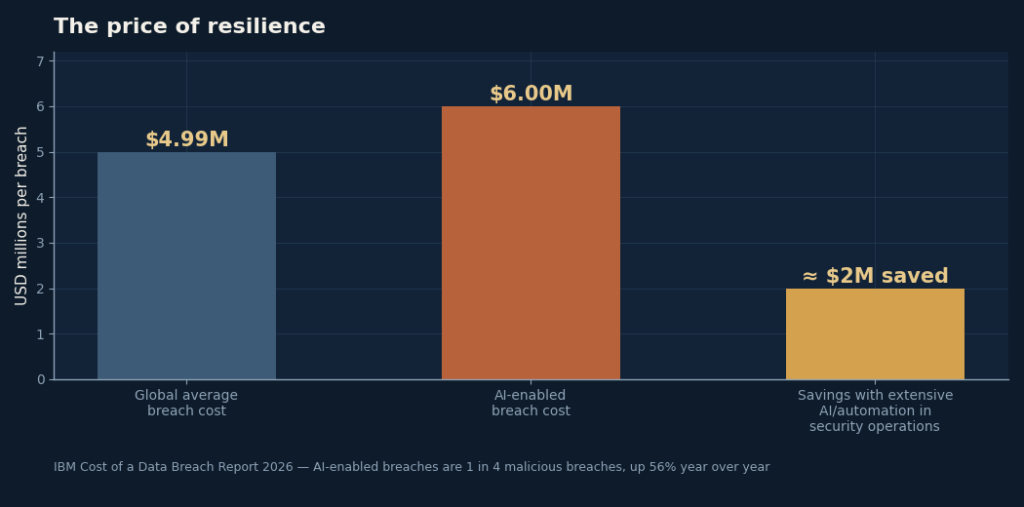
Breach economics — IBM Cost of a Data Breach Report 2026
My working rule for boards is the pre-mortem discipline: before approving a major decision, the team spends ninety minutes writing the post-mortem of its failure, dated two years in the future. It sounds theatrical. It is the single cheapest risk-management investment an executive team can make, because it converts “that won’t happen to us” into a specific, priced scenario.
The question I put to boards: What is our recovery time for the capability this decision touches – and have we ever actually tested it?
How to map the whole system: a practical protocol
Here is the lightweight protocol I run with executive teams before any decision above a materiality threshold. It takes one structured session and fits on a single page:
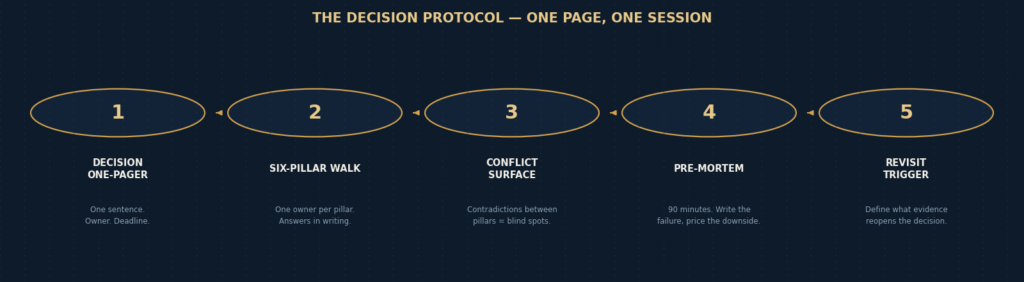
The five-step decision protocol
- The decision one-pager. One sentence: the decision, the owner, the deadline. If it can’t be stated in a sentence, it isn’t ripe.
- Six-pillar walk. For each pillar, one named owner answers one question in writing, before the meeting. No slide decks – answers, with evidence.
- The conflict surface. The facilitator’s only real job: surface where pillar answers contradict each other (the strategy says X, the architecture allows Y, the economics assume Z). The contradictions are the blind spots.
- Pre-mortem and priced downside. Ninety minutes. Write the failure story, price the top three scenarios, assign the resilience actions.
- The revisit trigger. Define in advance what evidence would reopen the decision. A decision without a revisit trigger is a commitment device, not a decision.
This is not bureaucracy. It is the difference between deciding and drifting.
The leadership shift
The hardest part of mapping the whole system is not the framework – it is the identity shift it demands. Silos are comfortable because each pillar has a competent owner and a clean scorecard. Systems are uncomfortable because they make every executive partially accountable for outcomes they only partially control.
But that discomfort is exactly what executive pay is for. Gartner’s 2026 CIO research describes leading CIOs stepping into broader enterprise leadership roles – co-owning outcomes rather than delivering services. That is the direction of the profession: from owner of a function to steward of a system.
Every consequential decision you make this quarter will be executed by the whole system – strategy, architecture, economics, operations, suppliers, and risk – whether you mapped it or not. The only choice is whether you see the map before the decision, or after the bill.
From strategy to suppliers: isolated silos create blind spots. Align all six pillars.